9/19/2017
6/19/2017
4/21/2017
12/17/2016
11/13/2016
2016/4 Rating List TOP PLAYERS / WORLD-TURKISH REPUBLIC
2/09/2016
An Interview with GM Dr. Murat Akdag
By
winning the Jaroslav Hybl Memorial A tournament you have completed
your GM norms and acquired the GM title. Can you narrate the poignant stages of the tournament highlighting important points.
I became a GM after the game where I beat the Croat GM Ljubičić, Ing. Leonardo (2630) on 12.2.2014 by making a novelty, in the Jaroslav Hybl Memorial A tournament . Ljubicic became the World Champion recently. I started correspondence chess in January 2004. It took me 10 years to become a GM. A. Dikmen and Fatih Atakisi have contributed greatly in my introduction into Correspondence Chess. In the first 6 years I generally played in a non-assertive way. The successful results of my close friend Tansel Turgut motivated me. I acquired GM norms in 4 of the 5 high level tournaments that I played in the last 4 years. According to the finished 253 games so far I have 82 wins, 165 draws and 6 defeats (65.02%).
![]() |
| GM Dr. Murat Akdağ |
Previously
you won the Turkish Championship and gained a second place in the AA
Zonal. What are your next targets? Do you have plans for the World
Championship?
My next target is to become the World Champion. I am planning to exert intensive effort in this direction in the following 5 years. Also I will try to surpass the 2600 resistance level by playing in category 12 or higher tournaments that I am invited to.
Do
you use game databases while searching for moves? In general when
you are searching for moves what kind of a procedure do you use?
During my search for moves I use 4 different databases. 1- OTB database I particularly check games with 2600 and plus rating. 2- Correspondence database 3- Engine database (with ECO code feature) 4- Opponent database In the opening stage I investigate my opponents games and try to find out positions that make them uncomfortable. In my choice of move with White this becomes the most important factor. After this investigation I either chose e4 or d4. I play Nf3 and c4 less often. I think in general d4 is better in Correspondence Chess. In general I check every position of a game with Komodo 9, Stockfish 6 and Houdini Pro 4. Apart from this I use engines like Fire 4 , Gull 3, Equinox 3.30 , Critter 1.6a , Deep Rybka 4.1 , Bouquet 1.8, Black Mamba 2.0 , Naum 4.6, Deep Fritz 14, Deep Shredder 12, Ivanhoe series and Hiarcs 14 in some positions.
There
are negative thoughts that appear in forums about the use of PCs in
correspondence chess. Can you tell us your opinion on this issue.
Due to PCs and tablebases can correspondence chess come to an end?
The most important hazard of the technological advances against humanity is its induction of the reduction of the use of the brain. Correspondence chess is a discipline where engine analysis, published and visual material research and intuitional abilities are blended. Unfortunately the technological advances in the recent years gave rise to soulless games where many people play by engine moves. However to reach the summit is possible only with human evaluation.
Can you analyse 3 of your games which you like the best for our viewers.
Do you find the prize money allocated for the Turkish Championship adequate? Do you think the Federation is showing enough interest towards correspondence chess? Can we take your opinion in these matters?
Unfortunately correspondence chess culture in our country is not at a sufficient level. An average tournament takes 1-1.5 years. Thousands of hours of labour and intensive toil.
It is good to see that in the recent years there are news about correspondence chess on TSF web site. The TSF under Gulkiz Tulay administration is the most successful federation I have seen so far. Thanks to her the community has taken a sigh of relief. The positive and constructive attitude of Gulkiz Tulay is the most important factor in this. I hope this administration continues in this direction for a very long time.
What are you insights about the future of correspondence chess in Turkey?
I played in some OTB games this year and I will continue to do so. My observation is this: there is a very talented below 20 generation that is slowly emerging. I think that this resource will feed the correspondence chess in Turkey.
Which player influenced you most?
Among Turks Tansel Turgut, from foreigners Reinhard Moll ( He has 10 GM norms!!)
What are your favorite openings and which stage of a chess game do you like the most?
With Black Queen's Gambit Accepted and Petroff. With White I chose the opening where my opponent has the worst score. In other terms I play every opening with White. I think I am much better in the endgame stage of a chess game. Frankly I don't think I have solved the opening stage in a satisfactory level.
Do you have a message and what are you advices to players who want to progress in correspondence chess?
I think correspondence chess will help to improve the repertory of professional OTB players. For chess fans it will help them to learn the opening techniques. Players who want to progress should not take on more than 30 games during a year. They should follow the computer and engine technologies closely and should own an equipped PC. They should have CB13. They also should have wide database potential.
Thank you.
1/19/2016
ICCF Rating List 2016-1 (Turkish-World)
2016-1 ICCF Rating List Turkish Contingency 2300+
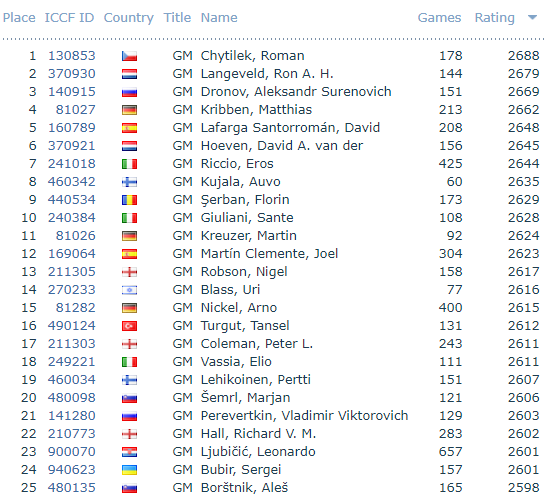
2016-1 ICCF Rating List Top 25
ChessActive 16 Million Game PGN Database
10/18/2015
IM NEVZAT SUER (1926-1987)
He
was born in 1926 in Istanbul. In 1946 he attained the 5th place at
Istanbul Chess Championship.
He
became the first Turkish IM together with Ilhan Onat in 1975 in
Italy.
Among
other tournaments abroad he represented the Turkish Republic in
Varna, Tel Aviv, Havana, Lugano, Skopje, Nice, Malta and Luzern
Olympics. He won the Turkish Chess Championship thrice in 68-69 and
1973. He wrote a chess column for the “Republican” newspaper for
17 years. This was the first chess column in Turkish history. He also
published the much cherished Suer Chess Magazine with his own means
till 1983.
The
Genius of Nevzat Suer
Now,
I strongly belive that Suer had an exceptional genius. To
demonstrate this I would like to narrate a story. One day N. Suer
suddenly came to my side and started telling me about a game he
played. According to the story he was playing in a local tournament
and his opponent played 1...f5 to everything except 1. e4. So what,
you may say but pls follow me till the end of the story. He said
that he played 1. e3 against his opponent and his opponent replied
with 1...f5 heartily.
1. e3 f5
You
may still be wondering what is so curious about this. Wait till you
see N. Suer's next move.
2. e4!!
2.
e4!! was the move Nevzat Suer played. Now Black is playing against
From Gambit (1.f4 e5) with colours reversed! The only other
alternative is to play 2...e5 and accept a King's Gambit with colours
reversed again. Since his opponent played and studied none of these
openings he had got into a squeeze. I was amazed and asked him what
his opponent did. He said that he played 2...e5 and lost in a few
moves because he did not know the basic plans pertaining to the
opening.
The
genius of Suer was to imagine this whole affair and virtualize it on
the board.
Music
Life of Nevzat Suer
We
learn much about Suer's musical life from his uncle. He was a very
sought after pianist in Turkey at that time and also played the
violin at the same virtuosity level.
Nevzat
Suer and Some Nice Stories
One
of the stories that I heard from FM A. Ipek was about when they went
abroad for a tournament.
They
were lodged at a hotel and the tournament began. Next day the team
got together at breakfast and N. Suer complained about the music
coming from outside at night. Some people agreed that the music was a
bit loud. Suer said “ No... No.. No... It is not the loudness of
the music that I am complaining about. It is the musician. He kept
playing the wrong note everytime at a certain point in the piece that
he was playing. He kept making the same mistake over and over again
and this kept me awake!”
He also arranged the participation of the Turkish contingency in the Havana Olympics and was awarded a chess analysis table by Fidel Castro.
What took place at
the Havana Olympics is shrouded in myths and legends. There are many
versions to the events taken place there. I was able to discern the
fact from the myth through Enis Bilyap who is the son of Siracettin
Bilyap who was one of the strong National Team players in the
Turkish contingency at the Havana Olympiad. He quotes his father
saying the following: “ An announcement was made that a
simultaneous display was to be made for the local residents. They
were looking for 50 volunteers willing to play in the simultaneous
exhibition from National Team players taking part in the Olympiad.
These volunteers were going to make a simultaneous exhibition for the
local residents and chess fans. It sounded a bit off but when the
oraganizers explained the logic entailed we were persuaded. In a
formation of 1000 people 50 Master players were going to place
themselves 20 players apart and move at the same intervals among the
players.
In the off day of
the Olympiad Nevzat and I went to the organization area for the
simultaneous. To describe the atmosphere there was impossible, one
must see it with their own eyes. There were players, tables, chess
sets and spectators in an area as large as 3-4 football fields. This
was a sight that I witnesses for the first time and I understood the
level of love for chess amongst the residents of Cuba. No nation
could be more passionate about chess than the Cubans. Of course
there is no need for me to mention the role Capablanca played in
this.
The simultaneous
started. We were with the most important players of the time and I
was enjoying myself immensely. Nevzat was playing 2 (tables) infront
of me. I think it was the 20th or the 21st move and suddenly a
tropical rain began. We tried to continue for a few seconds but then
all players began to search for a place to take cover. We too found
an appropriate place. The sun showed its face again after a rain that
took 30-40 mintes and everything went back to normal but the
simultaneous exhibition was called off.”
Suer
and Correspondence Chess
Suer
left a mark in all areas relating to chess and Correspondence Chess
was no exception.
He
played correspondence games and the only one I could find was the
one in the following link:
My
personal memories about N. Suer
N.
Suer always came to ISD (Istanbul Chess Association) to play chess
with his friends M. Boysan, D. Buyukozkaya and A. Ipek. They used to
play blitz. Sometimes Ilhan Onat used to come all the way from Izmir
and we witnessed a blitz showdown between the two IMs which everyone
watched.
One
day while talking, the subject came to his game with the Former World
Champion T. Petrossian. He had lost the game but he put the blame on
his tie. He said that his tie was too tight and prevented blood from
going to his brain and this gave rise to a loss. I smiled. I liked
his spirit!
He
lived as a bachelor and never got married. However I remember him
repeating the name of a lady called “Neval”. He used to say “Oh,
oh, Neval” now and then and very often. I personally think that it
was the name of his beloved. I hope they are finally together in the
afterworld.
10/08/2015
HOW TO ACHIEVE A NORM IN CORRESPONDENCE CHESS
HOW
TO ACHIEVE A NORM IN CORRESPONDENCE CHESS
To
clarify questions in the reader's mind about the requirements for a
title we can say the following: To claim a title from ICCF you have
to acquire 2 norms required by that title and the total of games
played must be equal to or more than 24. If you don't fullfill the
latter quota you will have to play another tournament and acquire a
norm in that tournament to bring your “played game” number to at
least 24.
There
are 3 titles that ICCF currently awards. These are the IM
(International Master), the SIM (Senior International Master) and the
GM (Grand Master) titles. To learn how to acquire Norms you should
see the chart on page 20 in the following link to find out how many
points are necessary:
http://documents.iccf.com.s3.amazonaws.com/Rules/ICCF
Tournament Rules 01.01.2015.pdf
The
award consist of a certificate and a medal and is given to you or
your country delegate at the next ICCF Congress following the date of
your achievement. The title is made public on the ICCF web page
immediately after your country delegate makes the necessary
application and you don't have to wait for the Congress for that.
But
what about the level of chess you have to play for this achievement?
I have to tell you that it is becoming harder everyday with the
introduction of strong chess engines which are being improved on a
daily basis it seems. At a time when we are hearing claims that
there is no point in playing correspondence chess because computers
are playing against each other and other claims of invincibility if
aided by a computer, I tried to evalute 3 games won and thus helped
to score the necessary points for an IM norm. I tried to give the
“Human” side of the evaluation and made comments about the
evaluations of the computer where appropriate.
1)
Baufays,Hugues (2343) - Kural,Aziz Serhat (2349)
EU/TC10/sf2 ICCF,
10.06.2014
1.e4 c5 2.¤f3 ¤c6 3.d4
cxd4 4.¤xd4 ¤f6 5.¤c3 e5 6.¤db5 d6 7.¥g5 a6 8.¤a3 b5 9.¥xf6
gxf6 10.¤d5
10.¤d5
Standard Pelikan
position. I strongly suggest to continue with the move 10...f5 here
as in the game.
10...f5 11.¥d3 ¥e6
12.0–0 ¥xd5 13.exd5 ¤e7 14.¤xb5
14.¤xb5
This move is not wrong;
it is playable but loses a tempo in the opening.
14... ¥g7 15.¤c3 e4
16.¥c4 0–0 17.£d2 ¤g6 18.¦ab1 ¦e8 19.¦fe1 ¥e5!
19...¥e5!
Beginning of difficulties
for White on the King's side.
20.g3 £f6! 21.¤d1?
21.¤d1?
21...¤h4!
21...¤h4! 22.¥e2 f4!
23.£b4 ¢h8! 0–1
(1)
Kural,Aziz Serhat (2349) - Liebert,Ervin (2398)
EU/TC10/sf2 ICCF,
10.06.2014
1.b4 d5 2.¥b2 £d6 3.a3
e5 4.e3 a5!
3...a5!
Testing for possibilities
to dismantle White's advance on the Queen's side.
5.b5 ¤f6 6.c4 ¥g4
7.¥e2 ¥xe2 8.£xe2 ¤bd7 9.d4 dxc4 10.¤f3 e4 11.¤e5 ¤b6 12.¤d2
£e6 13.0–0 ¥d6 14.¤exc4 ¤xc4 15.¤xc4 0–0 16.¦fc1 ¥e7
17.a4!
17.a4!
Black has shown that he
is planning to preserve the good Bishop to possibly place it on the
b8-h2 diagonal later. This move plans to exchange this Bishop from a3
and exert pressure on the c column.
17... ¤d5 18.¥a3 ¥b4
19.£b2 ¦fc8 20.¥xb4 axb4 21.¤d2 c6 22.b6!
22.b6!
The computer doesn't
favor this move. It doesn't even analyse it; yet it is one of the
most important moves that will affect the outcome of this game.
22...£e7 23.¦c5!
23.¦c5!
The setup is being
prepared for an initiative on the Queen's side.
23... ¦a6 24.a5 g6
25.¤b3 ¦ca8 26.¦ac1 ¢g7 27.£d2 £d6 28.¦1c4!
28.¦1c4!
The net is ready and
there are few things that Black can do to avoid the following
sacrifice. Of course I have to tell you that the computer did not see
the following sacrifice on b4 or the plan that led to its setup.
28... ¦d8 29.¦xb4! ¤xb4
30.£xb4
The position reached
after the positional sacrifice. The compuetr gives equality for the
position and it is a correct evaluation.
30...£e7 31.h3 ¦d5
32.¢f1!
32.¢f1!
The advance of the King
to b4 is necessary to relieve the Queen from its duties there. The
computer doesn't see this march and continues to give equality.
32...¦a8 33.£a4 £d6
34.¢e2 ¢f8 35.¦xd5 cxd5 36.¤c5 ¢e7
Now I completely
understand my opponent's idea to get the King to the protection of the
pawns on the Queen's side but the correct line of play was to keep
the Black Queen checking the f2 pawn to make sure that the White King
doesn't move anywhere else. But now with the King on e7 this is not
possible anymore.
37.£b5 ¦b8 38.¢d2!
38.¢d2!
Now the loss for Black is
unpreventable but I have to tell you that the computer doesn't see
the loss and gives Kd2 as the second move with equality evaluation at
depth 50!
38...f5 39.¢c3 g5
40.¢b4! 1–0
Now after I played the
move Kb4 and forced an anlysis from there, the computer changed its
evaluation and started giving a win to White! This game is a very
good example of a win that the computer could not fathom.
Now there are many ideas
here for White. The Qe2-h5 maneuver, the Nxb7 idea and the Qd7+ if
the Black Queen moves too far away.
(1)
Vekelis,Gintaras (2351) - Kural,Aziz Serhat (2349)
EU/TC10/sf2 ICCF,
10.06.2014
1.d4 ¤f6 2.¤f3 g6 3.c4
¥g7 4.¤c3 0–0 5.e4 d6 6.h3 e5 7.d5 ¤a6 8.¥g5 £e8
9.¥e3!? ¤h5 10.¦b1 f5
11.b4 £e7!
Preventing c5 for a
while.
12.¥e2 ¤f4 13.0–0 ¤b8
14.¦e1
14.¦e1
An attempt to sneak away
the Bishop from f1 and play g3 etc. later.
14...¤xe2+ 15.£xe2 f4
16.¥d2 g5 17.c5 g4 18.hxg4 ¥xg4 19.¦ec1 £e8 20.£d3
Centralizing the Queen
and moving it away from the pin.
20... a6 21.¤e1 ¦f7
The last two moves of
Black was for the protection of the c7 square.
22.a4 ¥f6 23.f3 ¥c8
24.¤d1 ¥h4 25.¦b2 ¥g3 26.£a3 ¤d7 27.¤d3 ¦f6 28.cxd6 cxd6
29.¤1f2 ¦g6 30.¦bc2 ¤f8
A classical King's Indian
game where White has the intiative on the Queen's side and Black will
try to infiltrate on the King's side.
31.b5 ¥d7 32.¥b4 £e7
33.¢f1 h5 34.bxa6 ¦xa6 35.a5 £h4 36.£b3 ¥b5 37.¤h3 ¦a8 38.¥d2
¥a6 39.¢g1 ¤d7!!
39...¤d7!!
Computer's 3rd
move. It is threatening a distant sacrifice on g4 among others. Now
White can prevent this, but only through a major reshuffle of his
pieces. In my view this is the winning move that may not attract the
attention of many chess players.
40.¥b4 ¦f8 41.¢h1 ¦f7
42.¦b2 ¢h7 43.£c2 £e7 44.£d1 £d8
The White Queen's entry
to c7 is not a major problem but the entry of the Rook should be
prevented.
45.¦cb1 ¦fg7 46.¥c3
White is hoping for a
sacrifice on b7 and the advance of the a5 pawn.
46... £h4 47.¥b4 b6!
47...b6!
If White takes on b6 and
then on d6 the Knight infiltrates through the c4 square.
48.¦c1 ¤c5 49.¤xc5
bxc5 50.¥c3 £e7 51.¦a1 ¥h4 52.¦aa2 ¦g8
Black is preventing the
last White dynamic which was taking on f4 with the Knight and
exchanging the Bishop with the Rook on g7.
53.¦b6 ¥c8 54.¦b8 c4!
54...c4!
This move should have
been taken into account. Now the Black Queen can control g1 from a7.
The march of the a6 pawn is perevented by enforcing tactics. Balck
has a clear winning position.
55.£f1 £a7 56.£b1 ¢h6
57.a6 ¥xh3 58.¦xg8 ¦xg8 59.£g1 £xg1+ 60.¢xg1 ¥d7
Black has won a piece and
the a6 pawn does not present a danger but careful play is needed.
61.¦b2 ¦a8 62.¦b6
¢h7! 63.¦xd6 ¥b5 64.¦b6 ¥xa6 65.¥xe5 ¥g3!
In other variations White
takes f4 and a very complicated endgame with reciprocative chances
presents itself.
The
title of this report should have been “The Level of Chess You have
to Play in order to Achieve a Norm in ICCF Nowadays”. I leave it
to the readers to make their own conclusions.
Subscribe to:
Posts (Atom)


